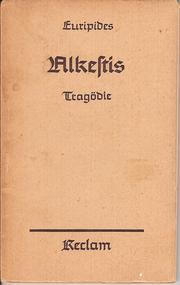
Alcestis
by Euripides
Alcestis (Greek mythology)Greek dramaGreek drama (Tragedy)great_books_of_the_western_worldDrama
3.6
Open LibraryAbout this book
"Euripides' Alcestic - perhaps the most anthologized Attic drama - is an ideal test for students reading their first play in the original Greek. Literary commentaries and language aids in most editions are too advanced or too elementary for intermediate students of the language, but in this new student edition, C. A. E. Luschnig and H. M. Roisman remedy such deficiencies." "The introductory section of this edition provides historical and literary perspective; the commentary explains points of grammar, syntax, and vocabulary, as well as elucidating background features such as dramatic conventions and mythology; and a discussion section introduces the controversies surrounding this most elusive drama. In their presentation, Luschnig and Roisman have initiated a new method for introducing students to current scholarship." "This edition also includes a glossary, an index, a bibliography, and grammatical reviews designed specifically for students of Greek language and culture in their second year of university study or third year of high school"--Book jacket.
Themes & subjects
Alcestis (Greek mythology)Greek dramaGreek drama (Tragedy)great_books_of_the_western_worldDramaopen_syllabus_project
Characters & people
About the author
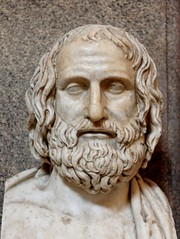
Euripides
480 BCE – 406 BCE
Euripides was the last of the three great tragedians of classical Athens (the other two being Aeschylus and Sophocles). Ancient scholars thought that Euripides had written ninety-five plays, although four of those were probably written by Critias. Eighteen or nineteen of Euripides' plays have survived complete. There has been debate about his authorship of Rhesus, largely on stylistic grounds and ignoring classical evidence that the play was his.[1] Fragments, some substantial, of most of the other plays also survive. More of his plays have survived than those of Aeschylus and Sophocles together, because of the unique nature of the Euripidean manuscript tradition. ([Source][1].) [1]…
Reviews
No reviews yet — be the first to write one from the Log screen.
Quotes
No quotes yet.