4.0
Open LibraryAbout this book
Overview: Prompted by his theories of heredity and environment, Zola set out to show Nana, "the golden fly", rising out of the underworld to feed on society--a predetermined product of her origins. Nana's latent destructiveness is mirrored in the Empire's, and they reflect each others' disintegration and final collapse in 1890. Built around the book's scientific skeleton is a powerful, sensual atmosphere and a rich use of words which elevate the novel beyond the realistic platform into a "poem of male desires." Part of Zola's famed Rougon-Macquart series of novels, this is the portrait of the scandal of Parisian society--Nana, a goddess of love who ruthlessly uses her sexuality to obtain wealth and to send her ruined lovers to the gutter from which she ascended. A tragic heroine ranking with Anna Karenina and Emma Bovary. Originally published in 1880, this is a new edition.
Themes & subjects
French fictionClassic LiteratureFictionProstitution in fictionHamburg.Prostitue
Setting
ParisFrance19th century
About the author
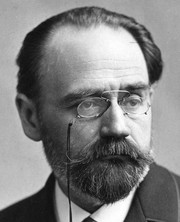
Émile Zola
2 April 1840 – 28 September 1902
Emile Zola was a French journalist and novelist known for his series of 20 novels known collectively as Les Rougon-Macquart (1871-93). Zola's style was called literary naturalism; his novels were attacked and even banned for their frankness and sordid detail, and caused quite a bit of controversy in their day. The same traits made him a best-selling author and a star of French literature in his day. In 1898 he then further incurred the wrath of French officials when he published the open letter "J'Accuse," in defense of Alfred Dreyfus, an Army officer who had been convicted of treason. Zola was sentenced to prison for libel, fled to England, and was granted amnesty a few months later. He die…
Reviews
No reviews yet — be the first to write one from the Log screen.
Quotes
No quotes yet.