First lines
"Is it possible to live in despair and not wish for death?"
About this book
Moravia's political fable about an Italian anti-Fascist and the frightened, suicide-seeking German girl he encounters on a boat to Capri--the setting of Moravia's Il disprezzo from 1954--was welcomed as one of his finest novels. Stephen Spender for The New York Review of Books commented: "One of the most brilliant strokes in this novel about relations in the Thirties between Italians and Germans is that Moravia never reveals whether his Italian narrator and hero is serious or not, and doubt about the seriousness lies in his being Italian.... This is the truth of the book: that within the external situation of the Italian Fascist--German Nazi relationship it is impossible to accept as authentic virtually anything people do." Moravia is not simply painting the portrait of an age but also coming to grips through his art with the great questions of all ages - the erotic, love, death, and the purposes of life. 1934 recapitulates the major themes of his art and at the same time takes us beyond them.
Themes & subjects
World history
First published 1982Setting
Capri (Italy)1934
About the author
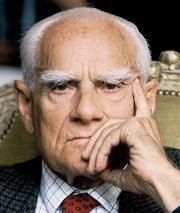
Alberto Moravia
28 nov 1907 – 26 sep 1990
Alberto Moravia is an Italian journalist, short-story writer, and novelist known for his fictional portrayals of social alienation and loveless sexuality. He was a major figure in 20th-century Italian literature. Moravia contracted tuberculosis of the bone (a form of osteomyelitis usually caused by Mycobacterium tuberculosis) at the age of 8, but, during several years in which he was confined to bed and two years in sanatoriums, he studied French, German, and English; read Giovanni Boccaccio, Ludovico Ariosto, William Shakespeare, and Molire; and began to write. Moravia was a journalist for a time in Turin and a foreign correspondent in London. His first novel, Gli indifferenti (1929; Tim…
Reviews
No reviews yet — be the first to write one from the Log screen.
Quotes
No quotes yet.