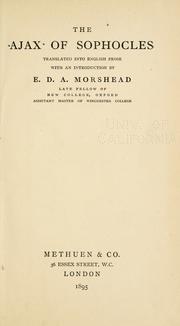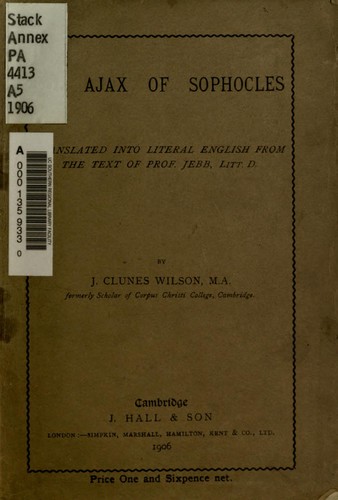
Ajax
by Sophocles
DramaAjax (Greek mythology)Translations into EnglishHeracles (Greek mythology)Translations into Italian
3.7
Open LibraryAbout this book
Brought boldly to life by Herbert Golder and Richard Pevear's translation and contextualized by Herbert Golder's eloquent introduction, this early Sophoclean tragedy tells the story of the Homeric hero better known as Ajax, who was second only to Achilles among the Greek warriors. In Greek tradition, Aias figures as the archaic warrior who dies in shame after his betrayal by the Greeks. Sophocles turns tradition inside out, portraying Aias' suicide not as a disgrace but as heroism. He endows Aias' suicide with a meaning radically different from previous versions of the Aias myth - Aias is not the hero whom time has passed by, but rather the man who steps beyond time. Most previous versions and interpretations have equivocated over Sophocles' bold vision. This edition of Aias translates precisely that transformation of the hero from the bygone figure to the man who transcends time.
Themes & subjects
DramaAjax (Greek mythology)Translations into EnglishHeracles (Greek mythology)Translations into ItalianCriticism and interpretation
Characters & people
About the author

Sophocles
496 B.C. – 406 B.C.
Sophocles (circa. 496 BCE - 406 BCE) was the second of the three ancient Greek tragedians whose work has survived to the present day. His first plays were written later than those of Aeschylus, and earlier than those of Euripides. According to the Suda, a 10th century encyclopedia, Sophocles wrote 120 or more plays during the course of his life, but only seven have survived in a complete form, namely Ajax, Antigone, Trachinian Women, Oedipus the King, Electra, Philoctetes and Oedipus at Colonus. For almost 50 years, Sophocles was the most-awarded playwright in the dramatic competitions of ancient Athens that took place during the religious festivals of the Lenaea and the Dionysia. Sophocles …
Reviews
No reviews yet — be the first to write one from the Log screen.
Quotes
No quotes yet.