fraeon
Films
BrowseTop 250
Series
TV ShowsAnimeTop 250 TVTop 100 Anime
Games
BrowseTop 100
Books
BooksMangaTop 125 BooksTop 100 Manga
For youTrendingTier ListsThe ArchiveLeaderboard
Log inSign up free
fraeon

Everything you watch, play and read — tracked, rated and remembered in one library.

Explore

  • Films
  • TV
  • Anime
  • Games
  • Books
  • Manga

Discover

  • Trending
  • Leaderboard
  • Find people
  • Lists
  • Tier lists

Company

  • Tour
  • About
  • Community guidelines
  • Privacy
  • Terms
  • Contact

© 2026 fraeon. All rights reserved. ·

Metadata from TMDB, RAWG, Jikan & Open Library. This product uses the TMDB API but is not endorsed or certified by TMDB.

Questions or ideas? mehmet@avortas.com

HomeFeedProfile
The efficiency paradox

The efficiency paradox

by Edward Tenner

Industrial efficiencySerendipityArtificial intelligenceBig dataBUSINESS & ECONOMICS
0.0
Open Library
Open Library

About this book

"A bold challenge to our obsession with efficiency--and a new understanding of how to benefit from the powerful potential of serendipity. Algorithms, multitasking, the sharing economy, life hacks: our culture can't get enough of efficiency. One of the great promises of the Internet and big data revolutions is the idea that we can improve the processes and routines of our work and personal lives to get more done in less time than ever before. There is no doubt that we're performing at higher levels and moving at unprecedented speed, but what if we're headed in the wrong direction? Melding the long-term history of technology with the latest headlines and findings of computer science and social science, The Efficiency Paradox questions our ingrained assumptions about efficiency, persuasively showing how relying on the algorithms of platforms can in fact lead to wasted efforts, missed opportunities, and above all an inability to break out of established patterns. Edward Tenner offers a smarter way of thinking about efficiency, revealing what we and our institutions, when equipped with an astute combination of artificial intelligence and trained intuition, can learn from the random and unexpected."-- "Bold challenge to our obsession with efficiency--and a new understanding of how to benefit from the powerful potential of serendipity"--

Themes & subjects

Industrial efficiencySerendipityArtificial intelligenceBig dataBUSINESS & ECONOMICSKnowledge Capital

Author

Edward Tenner

Pages

282

Read time

≈ 7h

Editions

1

Language

English

Publisher

Alfred A. Knopf

ISBN

9781400034888

Where to buy

TR
Amazon Bookshop

Reviews

No reviews yet — be the first to write one from the Log screen.

Quotes

No quotes yet.

Discussions

Similar books

The Principles of Scientific Management

Industrial management · Industrial efficiency

The Principles of Scientific Management

Frederick Winslow Taylor

1913

The engineers and the price system

Capitalism · Economic conditions

The engineers and the price system

Thorstein Veblen

1921

The Principles of Scientific Management

Industrial management · Industrial efficiency

The Principles of Scientific Management

Frederick Winslow Taylor

1911

The philosophy of management

Factory management · Industrial management

The philosophy of management

Oliver Sheldon

1923

Work, wages, and profits

Wages · Cost and standard of living

Work, wages, and profits

Henry Laurence Gantt

1910

Fatigue and efficiency

Industrial efficiency · Fatigue

Fatigue and efficiency

Josephine Clara Goldmark

1912

The human problems of an industrial civilization

Fatigue · Industrial efficiency

The human problems of an industrial civilization

Elton Mayo

1933

Lean Six Sigma For Dummies

Six sigma (quality control standard) · Industrial efficiency

Lean Six Sigma For Dummies

Martin Brenig-Jones

2009

Industrial psychology

Industrial efficiency · Ability

Industrial psychology

Joseph Tiffin

1942

Scientific management and railroads

Freight · Industrial efficiency

Scientific management and railroads

Louis Dembitz Brandeis

1911

Organizing for work

Industrial management · Industries

Organizing for work

Henry Laurence Gantt

1919

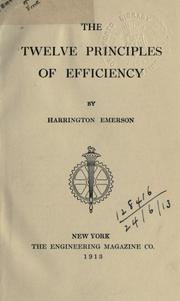
The twelve principles of efficiency

Industrial efficiency · Industrial engineering

The twelve principles of efficiency

Harrington Emerson

1912

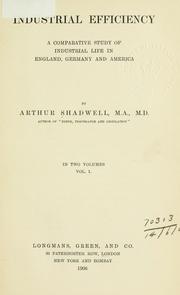
Industrial efficiency

Case studies · Industrial efficiency

Industrial efficiency

Shadwell, Arthur

1906

The Gantt chart

Industrial efficiency · Factory management

The Gantt chart

Wallace Clark

1922

At the fringes of science

Discoveries in science · Fraud in science

At the fringes of science

Michael W. Friedlander

1995

Gods without men

Serendipity · Missing children

Gods without men

Hari Kunzru

2011

Serendipity in anthropological research

Anthropology · Serendipity

Serendipity in anthropological research

Haim Hazan

2011

Noise channels

Cyberspace · Philosophy

Noise channels

Peter Krapp

2011