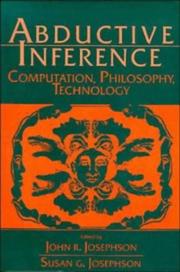
Abductive inference
Inferenz (Künstliche Intelligenz)Abduction (logique)Système base connaissancePEIRCEAbduktion (Logik)
0.0
Open LibraryAbout this book
Abduction is inference to the best explanation, a pattern of reasoning that occurs in such diverse places as medical diagnosis, scientific theory formation, accident investigation, language understanding, and jury deliberation. This book breaks new ground in the scientific, philosophical, and technological study of abduction. It presents new ideas about the inferential and information-processing foundations of knowledge and certainty. It argues that knowledge arises from experience by processes of abductive inference, in contrast with the view that knowledge arises noninferentially, or that deduction and inductive generalization are sufficient to account for knowledge. Abductive Inference reports key discoveries about abduction that were made as a result of designing, building, testing, and analyzing knowledge-based systems for medical diagnosis and other abductive tasks. These systems demonstrate that abductive inference can be described precisely enough to achieve good performance, even though this description lies largely outside the classical formal frameworks of mathematical logic and probability theory. The book tells the story of six generations of increasingly sophisticated generic abduction machines and the discovery of reasoning strategies that make it computationally feasible to form well-justified composite explanatory hypotheses despite the threat of combinatorial explosion. Finally, the book argues that perception is logically abductive and presents a layered-abduction computational model of perceptual information processing.
Themes & subjects
Inferenz (Künstliche Intelligenz)Abduction (logique)Système base connaissancePEIRCEAbduktion (Logik)Compréhension parole
Reviews
No reviews yet — be the first to write one from the Log screen.
Quotes
No quotes yet.