About this book
The setting is a society in which aging has been cured, individuals have indefinite lifespans, and population control is used to limit the population of the United States to forty million. This is maintained through a combination of infanticide and government-assisted suicide - in short, in order for someone to be born, someone must first volunteer to die. As a result, births are few and far between, and deaths occur primarily by accident. Everything was perfectly swell. There were no prisons, no slums, no insane asylums, no cripples, no poverty, no wars. All diseases were conquered. So was old age. Death, barring accidents, was an adventure for volunteers. Never, never, never -- not even in medieval Holland nor old Japan -- had a garden been more formal, been better tended. Every plant had all the loam, light, water, air and nourishment it could use. A hospital orderly came down the corridor, and looked in at the mural and the muralist. "Looks so real," he said, "I can practically imagine I'm standing in the middle of it." "What makes you think you're not in it?" said the painter. He gave a satiric smile. "It's called 'The Happy Garden of Life, ' you know."
Themes & subjects
Fiction, science fiction, general
About the author
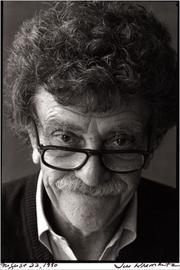
Kurt Vonnegut
11 November 1922 – 11 April 2007
Kurt Vonnegut, Jr. was an American novelist who wrote works blending satire, black comedy, and science fiction, such as [*Slaughterhouse-Five* (1969)][1], [*Cat's Cradle* (1963)][2], and [*Breakfast of Champions* (1973)][3]. He was known for his humanist beliefs as well as being honorary president of the American Humanist Association. He is widely considered one of the most influential American writers of the 20th century. [1]: https://openlibrary.org/works/OL98474W/Slaughterhouse-Five [2]: https://openlibrary.org/works/OL98482W/Cat's_Cradle [3]: https://openlibrary.org/works/OL98488W/Breakfast_of_Champions
Reviews
No reviews yet — be the first to write one from the Log screen.
Quotes
No quotes yet.