fraeon
Films
BrowseTop 250
Series
TV ShowsAnimeTop 250 TVTop 100 Anime
Games
BrowseTop 100
Books
BooksMangaTop 125 BooksTop 100 Manga
For youTrendingTier ListsThe ArchiveLeaderboard
Log inSign up free
fraeon

Everything you watch, play and read — tracked, rated and remembered in one library.

Explore

  • Films
  • TV
  • Anime
  • Games
  • Books
  • Manga

Discover

  • Trending
  • Leaderboard
  • Find people
  • Lists
  • Tier lists

Company

  • Tour
  • About
  • Community guidelines
  • Privacy
  • Terms
  • Contact

© 2026 fraeon. All rights reserved. ·

Metadata from TMDB, RAWG, Jikan & Open Library. This product uses the TMDB API but is not endorsed or certified by TMDB.

Questions or ideas? mehmet@avortas.com

HomeFeedProfile
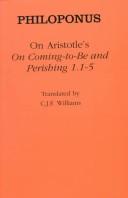
Philoponus

Philoponus

by Owen Goldin, John Philoponus, Michael Griffin

AristotleLogic, early works to 1800Knowledge, theory ofScience, methodologyScience, early works to 1800
4.0
Open Library
Open Library

About this book

"Aristotle described the scientific explanation of universal or general facts as deducing them through scientific demonstrations, that is, through syllogisms that met requirements of logical validity and explanatoriness which he first formulated. In Chapters 19-23, he adds arguments for the further logical restrictions that scientific demonstrations can neither be indefinitely long nor infinitely extendible through the interposition of new middle terms. Chapters 24-26 argue for the superiority of universal over particular demonstration, of affirmative over negative demonstration, and of direct negative demonstration over demonstration to the impossible. Chapters 27-34 discuss different aspects of sciences and scientific understanding, allowing us to distinguish between sciences, and between scientific understanding and other kinds of cognition, especially opinion. Philoponus' comments on these chapters are interesting especially because of his metaphysical analysis of universal predication and his understanding of the notion of subordinate sciences. We learn from his commentary that Philoponus believed in Platonic Forms as inherent in, and posterior to, the Divine Intellect, but ascribed to Aristotle an interpretation of Plato's Forms as independent substances, prior to the Demiurgic Intellect. A very important notion from Aristotle's Posterior Analytics is that of the 'subordination' of sciences, i.e. the idea that some sciences depend on 'higher' ones for some of their principles. Philoponus goes beyond Aristotle in suggesting a taxonomy of sciences, in which the subordin…

Themes & subjects

AristotleLogic, early works to 1800Knowledge, theory ofScience, methodologyScience, early works to 1800Soul

Authors

Owen Goldin, John Philoponus, Michael Griffin

Pages

224

Read time

≈ 6h

Editions

15

Language

English

Publisher

Bloomsbury Publishing Plc

ISBN

9781306723923

Where to buy

TR
Amazon Bookshop

Reviews

No reviews yet — be the first to write one from the Log screen.

Quotes

No quotes yet.
Discussions

Similar books

La Poetica

Metaphysics · Early works to 1800

La Poetica

Aristotle

1479

Nicomachean Ethics

Ethics · Early works to 1800

Nicomachean Ethics

Aristotle

1558

Poetics

Early works to 1800 · Aesthetics

Poetics

Aristotle

1536

Πολιτικά (Politiká)

Politics and government · Incunabula

Πολιτικά (Politiká)

Aristotle

1492

Physics

Physics textbooks · Outlines, syllabi

Physics

Aristotle

1472

De anima

Aristotle · Psychology, early works to 1850

De anima

Aristotle

1877

Simplicius

Aristotle · Astronomy, ancient

Simplicius

Simplicius

2011

Parts of animals

Zoology · Pre-Linnean works

Parts of animals

Aristotle

1853

Parva naturalia

Early works to 1800 · Psychology

Parva naturalia

Aristotle

1523

Aristotle

History & Surveys · PHILOSOPHY

Aristotle

William David Ross

1923

De generatione et corruptione

Early works to 1800 · Science

De generatione et corruptione

Aristotle

1556

Εὐθύδημος

Sophism (Greek philosophy) · Peripatetics

Εὐθύδημος

Plato

1833

The advancement of learning

Science · Methodology

The advancement of learning

Francis Bacon

1605

La logique

Logic · Early works to 1800

La logique

Antoine Arnauld

1662

Posterior analytics

Ancient Logic · Definition (Logic)

Posterior analytics

Aristotle

1901

Advancement of learning, and The new Atlantis

Utopias · Science

Advancement of learning, and The new Atlantis

Francis Bacon

1906

Prior Analytics

Early works to 1800 · Logic

Prior Analytics

Aristotle

1964

Philoponus

Early works to 1850 · Psychology

Philoponus

John Philoponus

1999