fraeon
Films
BrowseTop 250
Series
TV ShowsAnimeTop 250 TVTop 100 Anime
Games
BrowseTop 100
Books
BooksMangaTop 125 BooksTop 100 Manga
For youTrendingTier ListsThe ArchiveLeaderboard
Log inSign up free
fraeon

Everything you watch, play and read — tracked, rated and remembered in one library.

Explore

  • Films
  • TV
  • Anime
  • Games
  • Books
  • Manga

Discover

  • Trending
  • Leaderboard
  • Find people
  • Lists
  • Tier lists

Company

  • Tour
  • About
  • Community guidelines
  • Privacy
  • Terms
  • Contact

© 2026 fraeon. All rights reserved. ·

Metadata from TMDB, RAWG, Jikan & Open Library. This product uses the TMDB API but is not endorsed or certified by TMDB.

Questions or ideas? mehmet@avortas.com

HomeFeedProfile
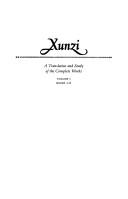
Xunzi

Xunzi

by Xunzi, Eric L. Hutton

Philosophy, chineseChinese PhilosophyConfucian PhilosophyPHILOSOPHYEastern
0.0
Open Library
Open Library

About this book

This is the first complete, one-volume English translation of the ancient Chinese text Xunzi, one of the most extensive, sophisticated, and elegant works in the tradition of Confucian thought. Through essays, poetry, dialogues, and anecdotes, the Xunzi articulates a Confucian perspective on ethics, politics, warfare, language, psychology, human nature, ritual, and music, among other topics. Aimed at general readers and students of Chinese thought, Eric Hutton's translation makes the full text of this important work more accessible in English than ever before. Named for its purported author, the Xunzi (literally, "Master Xun") has long been neglected compared to works such as the Analects of Confucius and the Mencius. Yet interest in the Xunzi has grown in recent decades, and the text presents a much more systematic vision of the Confucian ideal than the fragmented sayings of Confucius and Mencius. In one famous, explicit contrast to them, the Xunzi argues that human nature is bad. However, it also allows that people can become good through rituals and institutions established by earlier sages. Indeed, the main purpose of the Xunzi is to urge people to become as good as possible, both for their own sakes and for the sake of peace and order in the world.

Themes & subjects

Philosophy, chineseChinese PhilosophyConfucian PhilosophyPHILOSOPHYEasternGeneral

About the author

Xunzi

340 B.C. – 245 B.C.

Authors

Xunzi, Eric L. Hutton

Pages

432

Read time

≈ 11h

Editions

4

Language

English

Publisher

Princeton University Press

ISBN

9780691169316

Where to buy

TR
Amazon Bookshop

Reviews

No reviews yet — be the first to write one from the Log screen.

Quotes

No quotes yet.
Discussions

Similar books

The Art of War

Open Library Staff Picks · Early works to 1800

The Art of War

孙武 (Sun Tzu)

1900

Tao te Ching

Chinese Philosophy · Chinese language materials

Tao te Ching

老子

1842

Sein und Zeit

Espace et temps · Ontologie

Sein und Zeit

Martin Heidegger

1927

Lun yu

Chinese Philosophy · 儒家

Lun yu

Confucius

1750

Lunyu

Ethics · Philosophy, Chinese

Lunyu

Confucius

1904

Nanhua jing

Chinese Fables · Chinese Philosophy

Nanhua jing

Zhuangzi

1889

I Ching

I Ching · Mind, body, spirit: mysticism & self-awareness

I Ching

James Legge

1882

Xunzi

Chinese Philosophy · Chinese classics

Xunzi

Xunzi

1804

Han Feizi

Chinese Philosophy · Chinese classics

Han Feizi

Han Fei

1811

Meng-tzu

Quotations, maxims · Ethics

Meng-tzu

Mencius

1932

Zhongguo zhe xue shi

Ancient Philosophy · China

Zhongguo zhe xue shi

Feng, Youlan

1935

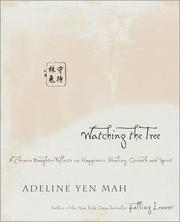
Watching the Tree

Chinese Philosophy · Civilization

Watching the Tree

Adeline Yen Mah

2000

Psychoanalysis in China

Psychoanalysis, philosophy · Philosophy, chinese

Psychoanalysis in China

David E. Scharff

2014

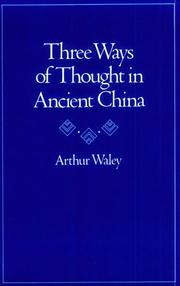
Three ways of thought in ancient China

Chinese Philosophy · Chinese filosofie

Three ways of thought in ancient China

Arthur Waley

1939

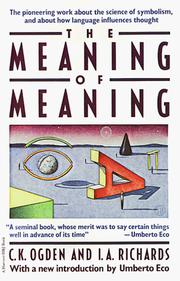
The meaning of meaning

Meaning (Psychology) · Criticism

The meaning of meaning

C. K. Ogden

1923

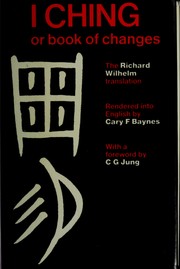
I Ching

Yijing <Werk> · I Ching

I Ching

Richard Wilhelm

1950

Cai gen tan

Buddhist meditations · Chinese Philosophy

Cai gen tan

Zicheng Hong

1926

Mengzi

Chinese Philosophy · Quotations

Mengzi

Mencius

1824