fraeon
Films
BrowseTop 250
Series
TV ShowsAnimeTop 250 TVTop 100 Anime
Games
BrowseTop 100
Books
BooksMangaTop 125 BooksTop 100 Manga
For youTrendingTier ListsThe ArchiveLeaderboard
Log inSign up free
fraeon

Everything you watch, play and read — tracked, rated and remembered in one library.

Explore

  • Films
  • TV
  • Anime
  • Games
  • Books
  • Manga

Discover

  • Trending
  • Leaderboard
  • Find people
  • Lists
  • Tier lists

Company

  • Tour
  • About
  • Community guidelines
  • Privacy
  • Terms
  • Contact

© 2026 fraeon. All rights reserved. ·

Metadata from TMDB, RAWG, Jikan & Open Library. This product uses the TMDB API but is not endorsed or certified by TMDB.

Questions or ideas? mehmet@avortas.com

HomeFeedProfile
Feynman's lost lecture

Feynman's lost lecture

by David L. Goodstein

1996Celestial mechanicsConic sectionsOrbitsPlanetsFeynman, richard p. (richard phillips), 1918-1988
3.5
Open Library
Open Library

About this book

"On March 13, 1964, Feynman delivered a lecture to the Caltech freshman class, "The Motion of Planets Around the Sun"why the planets move elliptically instead of in perfect circles. For reasons unknown, most probably for his own amusement, he chose to make the argument using mathematics no more advanced than high-school plane geometry. Isaac Newton had pulled off much the same trick nearly 300 years earlier in his masterpiece, the Principia. Feynman, unable to follow Newton's obscure proof, invented his own original, geometrical proof in the Caltech lecture." "The subject of Feynman's lecture was the watershed discovery that separated the ancient world discovery that separated the ancient world from the modern world - the culmination of the Scientific Revolution. Before Copernicus, Kepler, Galileo, and Newton, the universe was Earth-centered. After their discoveries, our idea of the universe steadily altered and expanded, moving outward to the infinity we try to understand in our own time. Thus Feynman deals here with a crowning achievement of the human mind, comparable to Beethoven's symphonies. Shakespeare's plays, or Michelangelo's Sistine Chapel. Feynman conclusively demonstrates the astonishing fact that has mystified and intrigued all deep thinkers since Newton's time: Nature obeys mathematics." "For thirty years this brilliant and seminal lecture lay dormant in the Caltech archives. Now, in this book, Feynman's lost lecture has been reconstructed and explained in meticulous detail together with a history of ideas of the planets' motions. Anyone who remembers high-sch…

Themes & subjects

Celestial mechanicsConic sectionsOrbitsPlanetsFeynman, richard p. (richard phillips), 1918-1988
First published 1996

Characters & people

About the author

David L. Goodstein

1939

Author

David L. Goodstein

First published

1996

Pages

191

Read time

≈ 5h

Editions

2

Language

English

Publisher

Vintage

ISBN

0099736217

Where to buy

TR
Amazon Bookshop

Reviews

No reviews yet — be the first to write one from the Log screen.

Quotes

No quotes yet.
Discussions

Similar books

Philosophiae naturalis principia mathematica

Mechanics · Dynamics of a particle

Philosophiae naturalis principia mathematica

Sir Isaac Newton

1687

Les méthodes nouvelles de la mécanique céleste

Celestial mechanics · Mechanics, Celestial

Les méthodes nouvelles de la mécanique céleste

Henri Poincaré

1892

Centrifugal force and gravitation

Celestial mechanics · Gravity

Centrifugal force and gravitation

John Harris

1873

Astronomy explained upon Sir Isaac Newton's principles

Early works to 1800 · Astronomy

Astronomy explained upon Sir Isaac Newton's principles

James Ferguson

1756

Oeuvres de D'Alembert

Philosophy · Mathematics

Oeuvres de D'Alembert

Jean Le Rond d'Alembert

1821

An Introduction to Celestial Mechanics

Celestial mechanics · 39.23 celestial mechanics

An Introduction to Celestial Mechanics

Forest Ray Moulton

1902

Dvizhenii͡a nebesnykh tel

Celestial mechanics · Piano quintets

Dvizhenii͡a nebesnykh tel

Ri͡abov, I͡U. A.

1961

Lecons de mécanique céleste professees a la Sorbonne

Celestial mechanics · Lunar theory

Lecons de mécanique céleste professees a la Sorbonne

Henri Poincaré

1905

History of physical astronomy

Astronomy · Astrophysics

History of physical astronomy

Grant, Robert

1852

Vorlesungen über Himmelsmechanik

Celestial mechanics · Three-body problem

Vorlesungen über Himmelsmechanik

Carl Ludwig Siegel

1956

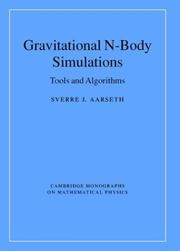
Gravitational N-Body Simulations

Celestial mechanics · Many-body problem

Gravitational N-Body Simulations

Sverre J. Aarseth

2003

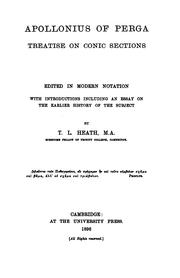
Conics

great_books_of_the_western_world · Early works to 1800

Conics

Apollonius of Perga

1655

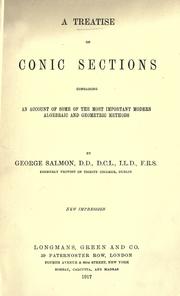
A treatise on conic sections

Analytic Geometry · Conic sections

A treatise on conic sections

George Salmon

1850

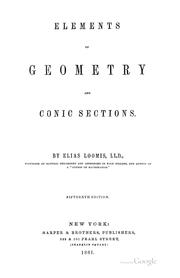
Elements of geometry, conic sections, and plane trigonometry

Geometry · Trigonometry

Elements of geometry, conic sections, and plane trigonometry

Elias Loomis

1847

A Treatise on Geometrical Conics

Conic sections

A Treatise on Geometrical Conics

Arthur Cockshott

1889

A treatise on conic sections

Analytic Geometry · Conic sections

A treatise on conic sections

George Salmon

1869

A treatise on plane co-ordinate geometry as applied to the straight line and the conic sections

Analytic Geometry · Conic sections

A treatise on plane co-ordinate geometry as applied to the straight line and the conic sections

Isaac Todhunter

1858

An elementary treatise on the geometry of conics

Conic sections · tangent

An elementary treatise on the geometry of conics

Asutosh Mookerjee

1893