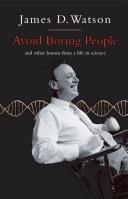
Avoid boring people
3.5
Open LibraryAbout this book
From a living legend--James D. Watson, who shared the Nobel Prize for having revealed the structure of DNA--a personal account of the making of a scientist. In Avoid Boring People, the man who discovered "the secret of life" shares the less revolutionary secrets he has found to getting along and getting ahead in a competitive world.Recounting the years of his own formation--from his father's birding lessons to the political cat's cradle of professorship at Harvard--Watson illuminates the progress of an exemplary scientific life, both his own pursuit of knowledge and how he learns to nurture fledgling scientists. Each phase of his experience yields a wealth of age-specific practical advice. For instance, when young, never be the brightest person in the room or bring more than one date on a ski trip; later in life, always accept with grace when your request for funding is denied, and--for goodness' sake--don't dye your hair. There are precepts that few others would find occasion to heed (expect to gain weight after you win your Nobel Prize, as everyone will invite you to dinner) and many more with broader application (do not succumb to the seductions of golf if you intend to stay young professionally). And whatever the season or the occasion: avoid boring people.A true believer in the intellectual promise of youth, Watson offers specific pointers to beginning scientists about choosing the projects that will shape their careers, the supreme importance of collegiality, and dealing with competitors within the same institution, even one who is a former mentor. Finally he addresse…
Themes & subjects
BiographyMolecular biologistsNatuurwetenschappenWetenschapsbeoefenaarsScientistsNonfiction
First published 2007Characters & people
Setting
United States
About the author
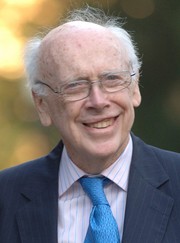
James D. Watson
1928 – 2025
Watson, James Dewey, 1928-, American biologist and educator, b. Chicago, Ill., grad. Univ. of Chicago, 1947, Ph.D. Univ. of Indiana, 1950. With F. H. C. Crick he began (1951) research on the molecular structure of deoxyribonucleic acid (DNA) at the Cavendish Laboratory at Cambridge. Their findings, published in 1953, resulted in the joint award to them and to M. H. F. Wilkins (on whose laboratory's in X-ray diffraction their studies were partly based) of the 1962 Nobel Prize in Physiology or Medicine. Watson joined the faculty at Harvard in 1955 and in 1968 became director of the Cold Spring Harbor Laboratory in New York. From 1989 to 1992 he was director of the National Center for Human Gen…
Reviews
No reviews yet — be the first to write one from the Log screen.
Quotes
No quotes yet.