fraeon
Films
BrowseTop 250
Series
TV ShowsAnimeTop 250 TVTop 100 Anime
Games
BrowseTop 100
Books
BooksMangaTop 125 BooksTop 100 Manga
For youTrendingTier ListsThe ArchiveLeaderboard
Log inSign up free
fraeon

Everything you watch, play and read — tracked, rated and remembered in one library.

Explore

  • Films
  • TV
  • Anime
  • Games
  • Books
  • Manga

Discover

  • Trending
  • Leaderboard
  • Find people
  • Lists
  • Tier lists

Company

  • Tour
  • About
  • Community guidelines
  • Privacy
  • Terms
  • Contact

© 2026 fraeon. All rights reserved. ·

Metadata from TMDB, RAWG, Jikan & Open Library. This product uses the TMDB API but is not endorsed or certified by TMDB.

Questions or ideas? mehmet@avortas.com

HomeFeedProfile

Facing Gaia

by Bruno Latour, Catherine Porter

Philosophy of natureScience, philosophyGaia hypothesisNature in literatureClimatic changes
0.0
Open Library
Open Library

About this book

"The emergence of modern sciences in the seventeenth century profoundly renewed our understanding of Nature. For the last three centuries new ideas of Nature have been continuously developed by theology, politics, economics, and science, especially the sciences of the material world. The situation is even more unstable today, now that we have entered an ecological mutation of unprecedented scale. Some call it the Anthropocene, but it is best described as a new climatic regime. And a new regime it certainly is, since the many unexpected connections between human activity and the natural world oblige every one of us to reopen the earlier notions of Nature and redistribute what had been packed inside. So the question now arises: what will replace the old ways of looking at Nature? This book explores a potential candidate proposed by James Lovelock when he chose the name "Gaia" for the fragile, complex system through which living phenomena modify the Earth. The fact that he was immediately misunderstood proves simply that his readers have tried to fit this new notion into an older frame, transforming Gaia into a single organism, a kind of giant thermostat, some sort of New Age goddess, or even divine Providence. In this series of lectures on "natural religion", Bruno Latour argues that the complex and ambiguous figure of Gaia offers, on the contrary, an ideal way to disentangle the ethical, political, theological, and scientific aspects of the now obsolete notion of Nature. He lays the groundwork for a future collaboration among scientists, theologians, activists, and artists a…

Themes & subjects

Philosophy of natureScience, philosophyGaia hypothesisNature in literatureClimatic changesPhilosophy

About the author

Bruno Latour

1947 – 9 Oct 2022

Authors

Bruno Latour, Catherine Porter

Pages

300

Read time

≈ 8h

Editions

5

Language

English

Publisher

Polity Press

ISBN

9780745684338

Where to buy

TR
Amazon Bookshop

Reviews

No reviews yet — be the first to write one from the Log screen.

Quotes

No quotes yet.

Discussions

Similar books

Walden

Biography · Homes and haunts

Walden

Henry David Thoreau

1854

De rerum natura

Latin Didactic poetry · Ancient Philosophy

De rerum natura

Titus Lucretius Carus

1486

Histoire naturelle

Natural history · Early works to 1800

Histoire naturelle

Georges-Louis Leclerc, comte de Buffon

1749

The Maine Woods

Description and travel · Travel

The Maine Woods

Henry David Thoreau

1803

Physics

Physics textbooks · Outlines, syllabi

Physics

Aristotle

1472

Nova Atlantis

Early works to 1800 · Education

Nova Atlantis

Francis Bacon

1627

Facundo, or, civilization and barbarism

Description and travel · History

Facundo, or, civilization and barbarism

Domingo Faustino Sarmiento

1868

Representative men

Biography · Philosophy of nature

Representative men

Ralph Waldo Emerson

1800

Sogenannte Monadologie und Principes de la nature et de la grace fondés en raison

Monadology · Early works to 1800

Sogenannte Monadologie und Principes de la nature et de la grace fondés en raison

Gottfried Wilhelm Leibniz

1728

The works of Francis Bacon

Philosophers · Science

The works of Francis Bacon

Francis Bacon

1740

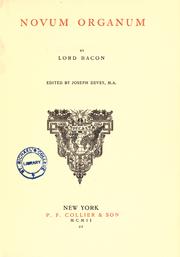
Novum organum

Early works to 1800 · Heat

Novum organum

Francis Bacon

1620

Experience and nature

Philosophy · Experience

Experience and nature

John Dewey

1925

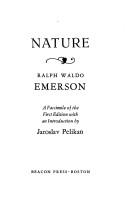
Nature

Nature · Literature

Nature

Ralph Waldo Emerson

1836

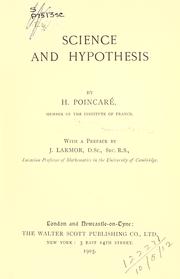
La science et l'hypothèse

Mathematics · Philosophy

La science et l'hypothèse

Henri Poincaré

1900

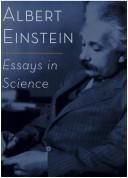
Mein Weltbild

Jews · Jews question

Mein Weltbild

Albert Einstein

1934

The Nature of the Physical World

Philosophy · Science

The Nature of the Physical World

Arthur Stanley Eddington

1928

The secret doctrine

Occultism · Teosofía

The secret doctrine

Елена Петровна Блаватская

1888

The Structure of Scientific Revolutions

Sciences · Histoire

The Structure of Scientific Revolutions

Thomas S. Kuhn

1955