fraeon
Films
BrowseTop 250
Series
TV ShowsAnimeTop 250 TVTop 100 Anime
Games
BrowseTop 100
Books
BooksMangaTop 125 BooksTop 100 Manga
For youTrendingTier ListsThe ArchiveLeaderboard
Log inSign up free
fraeon

Everything you watch, play and read — tracked, rated and remembered in one library.

Explore

  • Films
  • TV
  • Anime
  • Games
  • Books
  • Manga

Discover

  • Trending
  • Leaderboard
  • Find people
  • Lists
  • Tier lists

Company

  • Tour
  • About
  • Community guidelines
  • Privacy
  • Terms
  • Contact

© 2026 fraeon. All rights reserved. ·

Metadata from TMDB, RAWG, Jikan & Open Library. This product uses the TMDB API but is not endorsed or certified by TMDB.

Questions or ideas? mehmet@avortas.com

HomeFeedProfile

Logic Programming with Prolog

by Max Bramer

Logic programmingProlog (computer program language)GeneralProfessional, career & trade -> computer science -> generalProfessional, career & trade -> computer science -> programming languages (jr/sr)
0.0
Open Library
Open Library

About this book

Logic Programming is the name given to a distinctive style of programming, very different from that of conventional programming languages such as C++ and Java. By far the most widely used Logic Programming language is Prolog. Prolog is a good choice for developing complex applications, especially in the field of Artificial Intelligence. Logic Programming with Prolog does not assume that the reader is an experienced programmer or has a background in Mathematics, Logic or Artificial Intelligence. It starts from scratch and aims to arrive at the point where quite powerful programs can be written in the language. It is intended both as a textbook for an introductory course and as a self-study book. On completion readers will know enough to use Prolog in their own research or practical projects. Each chapter has self-assessment exercises so that readers may check their own progress. A glossary of the technical terms used completes the book. This second edition has been revised to be fully compatible with SWI-Prolog, a popular multi-platform public domain implementation of the language. Additional chapters have been added covering the use of Prolog to analyse English sentences and to illustrate how Prolog can be used to implement applications of an 'Artificial Intelligence' kind. Max Bramer is Emeritus Professor of Information Technology at the University of Portsmouth, England. He has taught Prolog to undergraduate computer science students and used Prolog in his own work for many years.

Themes & subjects

Logic programmingProlog (computer program language)GeneralProfessional, career & trade -> computer science -> generalProfessional, career & trade -> computer science -> programming languages (jr/sr)Sci14037

Author

Max Bramer

Pages

253

Read time

≈ 6h

Editions

3

Language

English

Publisher

Springer

ISBN

9781846282126

Where to buy

TR
Amazon Bookshop

Reviews

No reviews yet — be the first to write one from the Log screen.

Quotes

No quotes yet.

Discussions

Similar books

Logic for programming artificial intelligence and reasoning

Logic programming · Congresses

Logic for programming artificial intelligence and reasoning

Moshe Y. Vardi

2003

Foundations of Probabilistic Logic Programming

Logic programming · Machine theory

Foundations of Probabilistic Logic Programming

Fabrizio Riguzzi

2018

Discrete structures, logic, and computability

Computable functions · Computer science

Discrete structures, logic, and computability

James L. Hein

1994

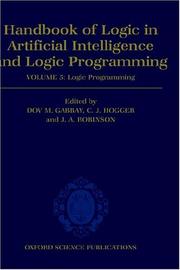
Handbook of logic in artificial intelligence and logic programming

Logic programming · Symbolic and mathematical Logic

Handbook of logic in artificial intelligence and logic programming

Dov M. Gabbay

1993

The experience of literature

Literature · Collections

The experience of literature

Lionel Trilling

1967

Rules and Reasoning

Semantics · Programming languages (electronic computers)

Rules and Reasoning

Stefania Costantini

2017

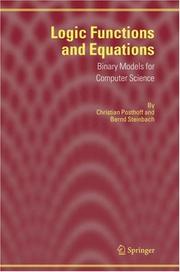
Logic functions and equations

Mathematics · Computer logic

Logic functions and equations

Christian Posthoff

2005

Heritage of Western civilization

Civilization · Collections

Heritage of Western civilization

John Louis Beatty

1958

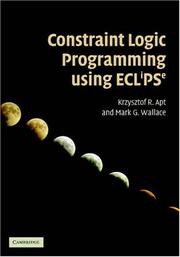
Constraint logic programming using ECLiPSe

Logic programming · Constraint programming (Computer science)

Constraint logic programming using ECLiPSe

Krzysztof R. Apt

2006

Programming with higher-order logic

Logic programming · Prolog (Computer program language)

Programming with higher-order logic

Dale Miller

2012

Mathematical Aspects Of Logic Programming Semantics

Logic programming · Programming languages (electronic computers)

Mathematical Aspects Of Logic Programming Semantics

Anthony Seda

2010

Logic Programming

Automatic theorem proving · Logic programming

Logic Programming

James H. Andrews

1992

Artificial intelligence

Artificial intelligence · Knowledge representation (Information theory)

Artificial intelligence

George F. Luger

1992

Programming in Prolog

Prolog (Computer program language) · Computer science

Programming in Prolog

William F. Clocksin

1981

Prolog programming for artificial intelligence

Artificial intelligence · Data processing

Prolog programming for artificial intelligence

Ivan Bratko

1986

Introduction to Natural Language Processing Through PROLOG

Natural language processing (computer science) · Prolog (computer program language)

Introduction to Natural Language Processing Through PROLOG

Clive Matthews

2016

Practical aspects of declarative languages

Declarative programming · Congresses

Practical aspects of declarative languages

Enrico Pontelli

2000

Concurrent Prolog

Prolog (Computer program language) · Parallel programming (Computer science)

Concurrent Prolog

Ehud Yehuda Shapiro

1987