4.6
Open LibraryFirst lines
The spacecraft was a long way from home, beyond the orbit of the outermost planet and high above the ecliptic plane-which is an imaginary flat surface that we can think of as something like a racetrack in which the orbits of the planets are mainly confined.
The spacecraft was a long way from home, beyond the orbit of the outermost planet and high above the ecliptic plane-which is an imaginary flat surface that we can think of as something like a racetrack in which the orbits of the planets are mainly confined.
About this book
“Fascinating . . . memorable . . . revealing . . . perhaps the best of Carl Sagan’s books.”—The Washington Post Book World (front page review) In Cosmos, the late astronomer Carl Sagan cast his gaze over the magnificent mystery of the Universe and made it accessible to millions of people around the world. Now in this stunning sequel, Carl Sagan completes his revolutionary journey through space and time. Future generations will look back on our epoch as the time when the human race finally broke into a radically new frontier—space. In Pale Blue Dot, Sagan traces the spellbinding history of our launch into the cosmos and assesses the future that looms before us as we move out into our own solar system and on to distant galaxies beyond. The exploration and eventual settlement of other worlds is neither a fantasy nor luxury, insists Sagan, but rather a necessary condition for the survival of the human race.
Themes & subjects
ExplorationPopular worksOuter spaceCosmologyOuter space, explorationAstronomy
First published 1994Setting
Outer space
About the author
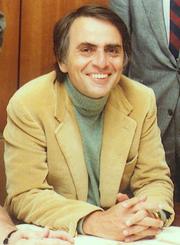
Carl Sagan
9 November 1934 – 20 December 1996
Carl Sagan was an American Pulitzer-prize winning author and astrophysicist. Sagan is the author of more than 600 publications. <q>“For me, it is far better to grasp the Universe as it really is than to persist in delusion, however satisfying and reassuring.” </cite>― Carl Sagan, The Demon-Haunted World: Science as a Candle in the Dark</cite></q>
Reviews
No reviews yet — be the first to write one from the Log screen.
Quotes
No quotes yet.