fraeon
Films
BrowseTop 250
Series
TV ShowsAnimeTop 250 TVTop 100 Anime
Games
BrowseTop 100
Books
BooksMangaTop 125 BooksTop 100 Manga
For youTrendingTier ListsThe ArchiveLeaderboard
Log inSign up free
fraeon

Everything you watch, play and read — tracked, rated and remembered in one library.

Explore

  • Films
  • TV
  • Anime
  • Games
  • Books
  • Manga

Discover

  • Trending
  • Leaderboard
  • Find people
  • Lists
  • Tier lists

Company

  • Tour
  • About
  • Community guidelines
  • Privacy
  • Terms
  • Contact

© 2026 fraeon. All rights reserved. ·

Metadata from TMDB, RAWG, Jikan & Open Library. This product uses the TMDB API but is not endorsed or certified by TMDB.

Questions or ideas? mehmet@avortas.com

HomeFeedProfile
Polyominoes

Polyominoes

by Solomon W. Golomb

1965PolyominoesMathematical recreationsPuzzlesGamesCombinatorial analysis
0.0
Open Library
Open Library

About this book

Inspiring popular video games like Tetris while contributing to the study of combinotorial geometry and tiling theory, polyominoes have continued to spark interest ever since their inventor, Solomon Golomb, introduced them to puzzle enthusiasts several decades ago. In this fully revised and expanded edition of his landmark book, the author takes a new generation of readers on a mathematical journey into the world of polyominoes, incorporoting the most important recent developments. Deceptively simple, polyominoes are a collection of squares joined together along their edges. But how many different polyominoes can you make with 5 squares, 6 squares, n squares? If you have a set of pentominoes (shapes consisting of five squares) could you cover a rectangle with them? What would happen if you had cubes instead of squares? Could you pack a box with them? Posing problems and giving answers along the way, Golomb invites the reader to play with these mathematical structures and develop on understanding of their extraordinary properties. In this new edition, he addresses, for example, the properties of octominoes and enneominoes and the problem of how to cover a donut with polyominoes. An extensive bibliography has been included to guide the reader to other interesting mathematical conundrums and to more advanced mathematical theories of polyominoes. For professional mathematicians and amateurs seeking further challenge, the author offers a host of new problems that remain to be solved.

Themes & subjects

PolyominoesMathematical recreationsPuzzlesGamesCombinatorial analysisPoetry (poetic works by one author)
First published 1965

About the author

Solomon W. Golomb
Solomon W. Golomb

30. Mai 1932 – 1. Mai 2016

Author

Solomon W. Golomb

First published

1965

Pages

182

Read time

≈ 5h

Editions

12

Language

English

Publisher

Allen & Unwin

ISBN

9780691215051

Where to buy

TR
Amazon Bookshop

Reviews

No reviews yet — be the first to write one from the Log screen.

Quotes

No quotes yet.

Discussions

Similar books

Polygons, polyominoes and polycubes

Polyominoes · Polygons

Polygons, polyominoes and polycubes

A. J. Guttmann

2009

Polyominoes

Polyominoes · Mathematical recreations

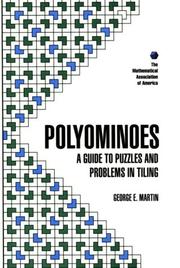
Polyominoes

Martin, George Edward

1991

Polyominoes

Packing grid figures

Joachim Wolffram

1994

Geometry · Polyominoes

3-D pentominoes activity book

Ernestine Giesecke

1996

Manipulatives (Education) · Polyominoes

The puzzling world of tangrams and pentominoes

Grant Jones

1994

Manipulatives (Education) · Mathematics

Try it! pentominoes

Marjorie Duby

2001

A Tangled Tale

Mathematical recreations · Fiction, short stories (single author)

A Tangled Tale

Lewis Carroll

1881

Mathematical recreations and problems of past and present times

Matter · Magic squares

Mathematical recreations and problems of past and present times

W. W. Rouse Ball

1892

The Game of Logic

Symbolic and mathematical Logic · Logic

The Game of Logic

Lewis Carroll

1886

O homem que calculava

Mathematical recreations · Araber

O homem que calculava

Malba Tahan

1993

Mathematics and the Imagination

Mathematical recreations · Mathématiques

Mathematics and the Imagination

Edward Kasner

1940

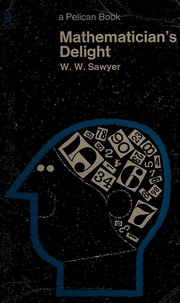
Mathematician's delight

Mathematics · Mathematical recreations

Mathematician's delight

W. W. Sawyer

1943

Kalejdoskop matematyczny

Mathematical recreations · Mathematics

Kalejdoskop matematyczny

Hugo Steinhaus

1938

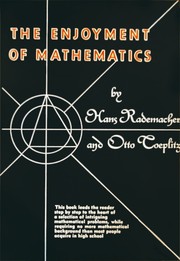
The Enjoyment of Mathematics

Mathematical recreations · Mathematics

The Enjoyment of Mathematics

Hans Rademacher

1930

The Gentle Art of Mathematics

Mathematical recreations · Mathematics

The Gentle Art of Mathematics

Daniel Pedoe

1958

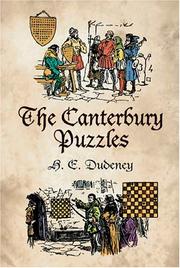
The Canterbury puzzles

Puzzles · Riddles

The Canterbury puzzles

Henry Ernest Dudeney

1907

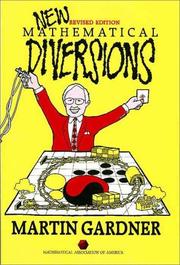
New Mathematical Diversions from Scientific American

Mathematical recreations · Puzzles

New Mathematical Diversions from Scientific American

Martin Gardner

1966

The Scientific American Book of Mathematical Puzzles & Diversions

Mathematical recreations · Games of strategy (mathematics)

The Scientific American Book of Mathematical Puzzles & Diversions

Martin Gardner

1959