First lines
Of course the artist always chooses her stitch; and she is free to alter it as occasion may demand; but a good workwoman (and the embroidress is a needlewoman first and an artist afterwards, perhaps) adopts in every case a method, and departs from it only for very good reason.
The effect of knotting in the mass is shown in Illustration 31, embroidered entirely in knots, contradicting, it might seem, what was said above about its unfitness for outline work. The lines, even the voided ones, are, here as sharp as could be; but then, it is not so many of us who work, knot by knot, with the marvellous precision of a Chinaman.
Darning has a homely sound, but it is useful for more than mending. In embroidery you no longer use it to replace threads worn away, but build up upon the scaffolding of a merely serviceable materal what may be a gorgeous design in silk
About this book
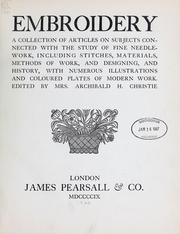
At the turn of the 20th century, machine embroidery began to overtake hand work. Lewis F. Day and Mary Buckle look back on embroidery in history, not always flattering, and talk about the relationship between the embroiderer and the designer.
Themes & subjects
NeedleworkEmbroiderytapestry
First published 1900Setting
SpainChina1900
About the author
Lewis Foreman Day
1845 – 1910
Reviews
No reviews yet — be the first to write one from the Log screen.
Quotes
No quotes yet.