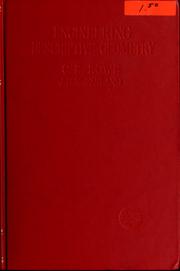
Applied descriptive geometry
Descriptive GeometryDrawing-room practiceProblems, exercisesSkullDiagnostic imaging
0.0
Open LibraryAbout this book
*Preface* The fundamental principles of descriptive geometry are few and comparatively simple and practically the same as they were fifty years ago. But engineers today are much more aware of the extreme value and usefulness of these principles for solving problems arising in their work. The chief objective of the author in offering this text to the profession is to place the major emphasis on the application of these principles, as stated in the title ***Applied Descriptive Geometry***. The method followed is to start the student out with simple three-view orthographic projection. He is also required to draw other objects, for which he will see that it is necessary to know how to draw any kind of an auxiliary view. After he has become thoroughly familiar with the methods of drawing an object in any view desired, the ordinary point-line-plane problems are introduced and are solved by the same orthographic methods. No mention is made of quadrants or angles of projection; the solutions are all obtained by the change-of-position or draftsman's method. A chapter is then presented giving the revolution method for solving many of the same problems. The following chapter, which the author believes to be unique in its application of the same principles to the graphical solution of noncoplanar structural and vector problems, will have the student keenly interested. The usual problems on curved lines and surfaces are introduced with particular emphasis placed on cone and cylinder problems because they occur most frequently in engineering practice. The last two chapters are devoted…
Themes & subjects
Descriptive GeometryDrawing-room practiceProblems, exercisesSkullDiagnostic imagingRadiography
About the author
Frank M. Warner
1884
Reviews
No reviews yet — be the first to write one from the Log screen.
Quotes
No quotes yet.