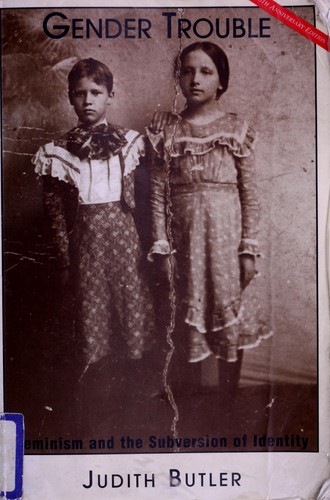
Gender Trouble
3.7
Open LibraryFirst lines
For the most part, feminist theory has assumed that there is some existing identity, understood through the category of women, who not only initiates feminist interests and goals within discourse, but constitutes the subject for whom political representation is pursued.
For the most part, feminist theory has assumed that there is some existing identity, understood through the category of women, who not only initiates feminist interests and goals within discourse, but constitutes the subject for whom political representation is pursued.
About this book
One of the most talked-about scholarly works of the past fifty years, Judith Butler’s Gender Trouble is as celebrated as it is controversial. Arguing that traditional feminism is wrong to look to a natural, 'essential' notion of the female, or indeed of sex or gender, Butler starts by questioning the category 'woman' and continues in this vein with examinations of 'the masculine' and 'the feminine'. Best known however, but also most often misinterpreted, is Butler's concept of gender as a reiterated social performance rather than the expression of a prior reality. Thrilling and provocative, few other academic works have roused passions to the same extent.
Themes & subjects
Feminist theoryFemininitySex roleSex differences (Psychology)Identity (Psychology)Geschlechtsidentität
First published 1990About the author

Judith Butler
24 February 1956
Judith Butler (born February 24, 1956) is an American philosopher and gender theorist whose work has influenced political philosophy, ethics and the fields of third-wave feminist, queer and literary theory. Since 1993, she has taught at the University of California, Berkeley, where she is now Maxine Elliot Professor in the Department of Comparative Literature and the Program of Critical Theory. She is also the Hannah Arendt Chair at the European Graduate School. Butler is best known for her books *Gender Trouble: Feminism and the Subversion of Identity* (1990) and *Bodies That Matter: On the Discursive Limits of Sex* (1993), in which she challenges conventional notions of gender and devel…
Reviews
No reviews yet — be the first to write one from the Log screen.
Quotes
No quotes yet.