0.0
Open LibraryAbout this book
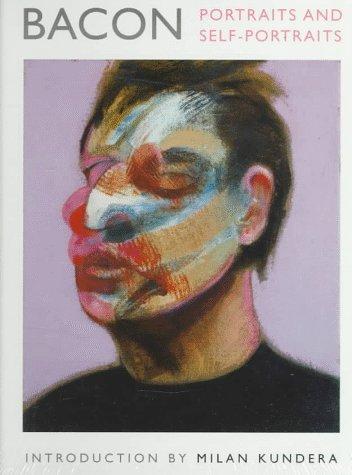
Francis Bacon's tormented self-images, his brutal portrayals of friends and fellow artists, and his deformations and stylistic distortions of classicism have broken the mould of portraiture; no other painter of the twentieth century has so drastically overturned the genre. Bacon: Portraits and Self-Portraits, published in association with the Estate of Francis Bacon, is the first book to be dedicated to this aspect of his work. With superb reproductions of more than 130 studies and portraits, including those of Lucian Freud, George Dyer, John Edwards, Isabel Rawsthorne, Mick Jagger, Muriel Belcher and Henrietta Moraes, Bacon: Portraits and Self-Portraits offers new insight into these radical and disturbing images. Many details are included, revealing for the first time the varied textures of Bacon's paint surface. Milan Kundera, the famed Czech novelist, provides a perceptive introduction, explaining his response to Bacon's works, while France Borel sets them in the context of his life and influences, and explains his pioneering approach to portraiture.
Themes & subjects
CatalogsExhibitionsPortraitsFigurative expressionismSelf-portraitsCriticism and interpretation
Characters & people
Setting
England
About the author
Francis Bacon
28 October 1909 – 28 April 1992
Francis Bacon was a figurative painter. His artwork is known for its bold, austere, graphic and often beautiful yet tortured imagery. Abstract figures often appear isolated in glass or steel geometrical cages set against flat, nondescript backgrounds. Bacon had begun painting by his early 20s, yet he worked only sporadically and without commitment during the late 1920s and early 1930s, when he worked as an interior decorator and designer of furniture and rugs. He later admitted that his career was delayed because he had spent so long looking for a subject that would sustain his interest. His breakthrough came with the 1944 triptych Three Studies for Figures at the Base of a Crucifixion, a…
Reviews
No reviews yet — be the first to write one from the Log screen.
Quotes
No quotes yet.