fraeon
Films
BrowseTop 250
Series
TV ShowsAnimeTop 250 TVTop 100 Anime
Games
BrowseTop 100
Books
BooksMangaTop 125 BooksTop 100 Manga
For youTrendingTier ListsThe ArchiveLeaderboard
Log inSign up free
fraeon

Everything you watch, play and read — tracked, rated and remembered in one library.

Explore

  • Films
  • TV
  • Anime
  • Games
  • Books
  • Manga

Discover

  • Trending
  • Leaderboard
  • Find people
  • Lists
  • Tier lists

Company

  • Tour
  • About
  • Community guidelines
  • Privacy
  • Terms
  • Contact

© 2026 fraeon. All rights reserved. ·

Metadata from TMDB, RAWG, Jikan & Open Library. This product uses the TMDB API but is not endorsed or certified by TMDB.

Questions or ideas? mehmet@avortas.com

HomeFeedProfile
Fermat's last theorem

Fermat's last theorem

by Amir D. Aczel

1996Fermat's last theoremGrand théorème de FermatMATHEMATICSAlgebraIntermediate
3.5
Open Library
Open Library

First lines

Just before dawn on June 23, 1993, Professor John Conway approached the darkened mathematics building on the Princeton University campus.

About this book

In 1995, a Princeton-based mathematician showed up at a scientific conference and dropped a bombshell. He had succeeded in deciphering one of mathematics' great secrets, one that thousands had puzzled over for the last three-and-a-half centuries: he had proven Fermat's Last Theorem in a 200-page paper, one that took seven years to write (and another year to fine tune). Fermat's Last Theorem is the previously untold story of the people, the history, and the cultures that lie behind this scientific triumph. Written by a seventeenth-century French scholar, the deceptively simple-sounding theorem states that while the square of a whole number can be broken down into two other squares of whole numbers - for example, five squared (25) equals four squared (16) plus three squared (nine) - the same cannot be done with cubes or any higher powers. After Fermat's death, many spent lifetimes trying to prove the theorem. The theorem has ancient roots. Around 2000 B.C., the Babylonians sought a way to break down a squared number into a sum of two squares. In the sixth century B.C., the Greek mathematician Pythagoras incorporated this concept into his own famous theorem, paving the way for Fermat. Centuries after Fermat, in 1955, two Japanese mathematicians made a far-reaching, almost fantastic conjecture about a possible relation between two disparate branches of mathematics. It was their work that enabled Princeton researcher Andrew Wiles, forty years later, to piece together the logic necessary to prove Fermat's Last Theorem. Fermat's Last Theorem combines philosophy and hard scienc…

Themes & subjects

Fermat's last theoremGrand théorème de FermatMATHEMATICSAlgebraIntermediate
First published 1996

About the author

Amir D. Aczel
Amir D. Aczel

November 6, 1950 – November 26, 2015

Amir Dan Aczel was an Israeli-born American lecturer and author of popular books on mathematics and science.

Author

Amir D. Aczel

First published

1996

Pages

160

Read time

≈ 4h

Editions

9

Languages

English, Italian, Spanish

Publisher

Four Walls Eight Windows

ISBN

9788851520823

Where to buy

TR
Amazon Bookshop

Reviews

No reviews yet — be the first to write one from the Log screen.

Quotes

No quotes yet.
Discussions

Across media

The same story in other forms.

the film

Fermat's Last Theorem

Similar books

Fermat's Last Theorem

Fermat's last theorem · mathematics

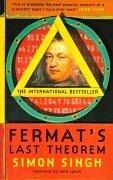
Fermat's Last Theorem

Simon Singh

1997

Algebraic number theory

Algebraic number theory · Fermat's last theorem

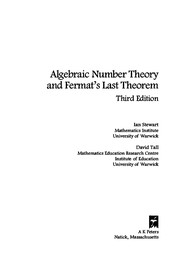
Algebraic number theory

Ian Stewart

1979

The Last Theorem

Fiction · Science Fiction

The Last Theorem

Arthur C. Clarke

2008

Invitation to the mathematics of Fermat-Wiles

Elliptic Curves · Fermat's last theorem

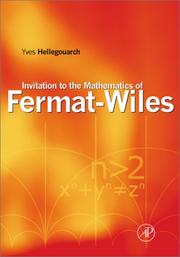
Invitation to the mathematics of Fermat-Wiles

Yves Hellegouarch

2001

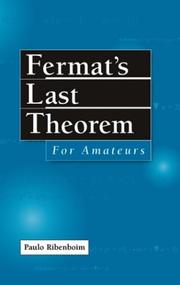
Fermat's last theorem for amateurs

Fermat's last theorem · Mathematics

Fermat's last theorem for amateurs

Paulo Ribenboim

1999

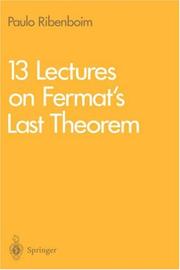
13 lectures on Fermat's last theorem

Fermat's last theorem · Fermat's theorem

13 lectures on Fermat's last theorem

Paulo Ribenboim

1979

Modular Forms and Fermat's Last Theorem

Congresses · Curves, Elliptic

Modular Forms and Fermat's Last Theorem

Gary Cornell

2000

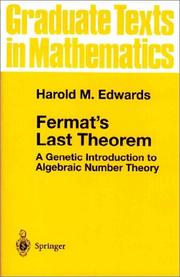
Fermat's last theorem

Fermat's last theorem · Algebraic number theory

Fermat's last theorem

Harold M. Edwards

1977

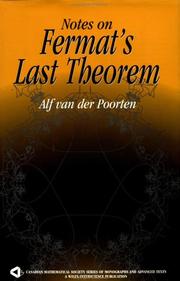
Notes On Fermat's Last Theorem

Fermat's last theorem

Notes On Fermat's Last Theorem

A. J. Van Der Poorten

1996

Modular Forms and Fermat's Last Theorem

Fermat's last theorem · Congresses

Modular Forms and Fermat's Last Theorem

Gary Cornell

1997