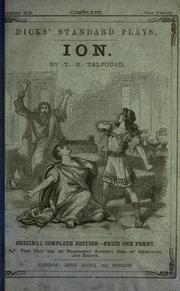
Ion
by Euripides
DramaIon (Greek mythology)Translations into EnglishTheseus (Greek mythology)Seven against Thebes (Greek mythology)
4.0
Open LibraryAbout this book
he Ion is the shortest, or nearly the shortest, of all the writings which bear the name of Plato, and is not authenticated by any early external testimony. The grace and beauty of this little work supply the only, and perhaps a sufficient, proof of its genuineness. The plan is simple; the dramatic interest consists entirely in the contrast between the irony of Socrates and the transparent vanity and childlike enthusiasm of the rhapsode Ion. The theme of the Dialogue may possibly have been suggested by the passage of Xenophon's Memorabilia in which the rhapsodists are described by Euthydemus as 'very precise about the exact words of Homer, but very idiotic themselves.' (Compare Aristotle, Met.) Ion the rhapsode has just come to Athens; he has been exhibiting in Epidaurus at the festival of Asclepius, and is intending to exhibit at the festival of the Panathenaea. Socrates admires and envies the rhapsode's art; for he is always well dressed and in good company--in the company of good poets and of Homer, who is the prince of them. In the course of conversation the admission is elicited from Ion that his skill is restricted to Homer, and that he knows nothing of inferior poets, such as Hesiod and Archilochus;--he brightens up and is wide awake when Homer is being recited, but is apt to go to sleep at the recitations of any other poet. 'And yet, surely, he who knows the superior ought to know the inferior also;--he who can judge of the good speaker is able to judge of the bad. And poetry is a whole; and he who judges of poetry by rules of art ought to be able to judge of all …
Themes & subjects
DramaIon (Greek mythology)Translations into EnglishTheseus (Greek mythology)Seven against Thebes (Greek mythology)Orestes (Greek mythology)
Characters & people
About the author
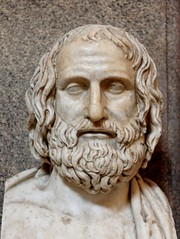
Euripides
480 BCE – 406 BCE
Euripides was the last of the three great tragedians of classical Athens (the other two being Aeschylus and Sophocles). Ancient scholars thought that Euripides had written ninety-five plays, although four of those were probably written by Critias. Eighteen or nineteen of Euripides' plays have survived complete. There has been debate about his authorship of Rhesus, largely on stylistic grounds and ignoring classical evidence that the play was his.[1] Fragments, some substantial, of most of the other plays also survive. More of his plays have survived than those of Aeschylus and Sophocles together, because of the unique nature of the Euripidean manuscript tradition. ([Source][1].) [1]…
Reviews
No reviews yet — be the first to write one from the Log screen.
Quotes
No quotes yet.