Andromache
by Euripides
DramaAndromache (Legendary character)Greek language materialsDrama (dramatic works by one author)Continental european drama (dramatic works by one author)
4.0
Open LibraryAbout this book
"In Andromache, Euripides challenges our concept of tragic character as he transforms our expectations of tragic structure. Through its subtly varied metrics, the play develops an increasingly complex plot and concludes with a simultaneous realization of realism and supernaturalism.". "The play takes place in the aftermath of the Trojan War. Andromache has become a concubine to Achilles' son, Neoptolemus, bearing him a child, Molossus. The captive Andromache is haunted by memories of her former life and by her love for Hector and their son Astyanax, both slain by the Greeks who are now her masters. As the play opens, Andromache and Molossus are threatened with death by Neoptolemus' young wife, Hermione, who has been unable to conceive a child and is fiercely jealous. The struggle between the two women is mirrored in the conflict between Peleus, who arrives to defend Andromache, and Menelaus, who arrives to help his daughter Hermione complete her bid for power."--BOOK JACKET.
Themes & subjects
DramaAndromache (Legendary character)Greek language materialsDrama (dramatic works by one author)Continental european drama (dramatic works by one author)Pa3973.a6
About the author
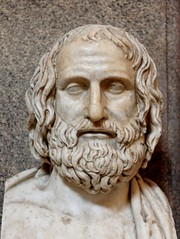
Euripides
480 BCE – 406 BCE
Euripides was the last of the three great tragedians of classical Athens (the other two being Aeschylus and Sophocles). Ancient scholars thought that Euripides had written ninety-five plays, although four of those were probably written by Critias. Eighteen or nineteen of Euripides' plays have survived complete. There has been debate about his authorship of Rhesus, largely on stylistic grounds and ignoring classical evidence that the play was his.[1] Fragments, some substantial, of most of the other plays also survive. More of his plays have survived than those of Aeschylus and Sophocles together, because of the unique nature of the Euripidean manuscript tradition. ([Source][1].) [1]…
Reviews
No reviews yet — be the first to write one from the Log screen.
Quotes
No quotes yet.